Enterprises are investing heavily in AI, yet relatively little of it reaches production. The published evidence is consistent on this point: a 2025 MIT study of more than 300 enterprise AI deployments found that roughly 95% of generative-AI pilots delivered no measurable return, and S&P Global reported that organisations scrapped close to half of their AI proofs-of-concept before they reached production. The explanations differ in detail, but a common thread runs through the analyses — and it is a governance pattern more than a technology one.
Reading across that body of work, two failure modes recur, and they look like opposites. In the first, an initiative is careful and compliant but aimed at work that was never worth automating — well governed, with little return to show for it. In the second, a capable demonstration runs on data nobody owns or can trace, and so it never earns enough confidence to enter a real decision. One is safe but without value; the other shows value but cannot be trusted. The symptoms differ; the underlying cause is the same — AI governed on a single dimension.
Where my vantage point comes in
I come to this from three disciplines I have spent a career in: data management and governance, enterprise architecture, and — since establishing the Aiconomica brand in 2017 — the economics of AI. That combination makes the governance gap easier to name. The frameworks the field relies on are each strong on one half of the problem. The risk-and-compliance standards — NIST's AI Risk Management Framework, ISO/IEC 42001, the EU AI Act — address whether AI is done right. The value-and-architecture disciplines — enterprise architecture (TOGAF), ROI and capability-based planning — address whether it is worth doing. Each governs one wing well. Few put both wings on the same airframe.
Two wings
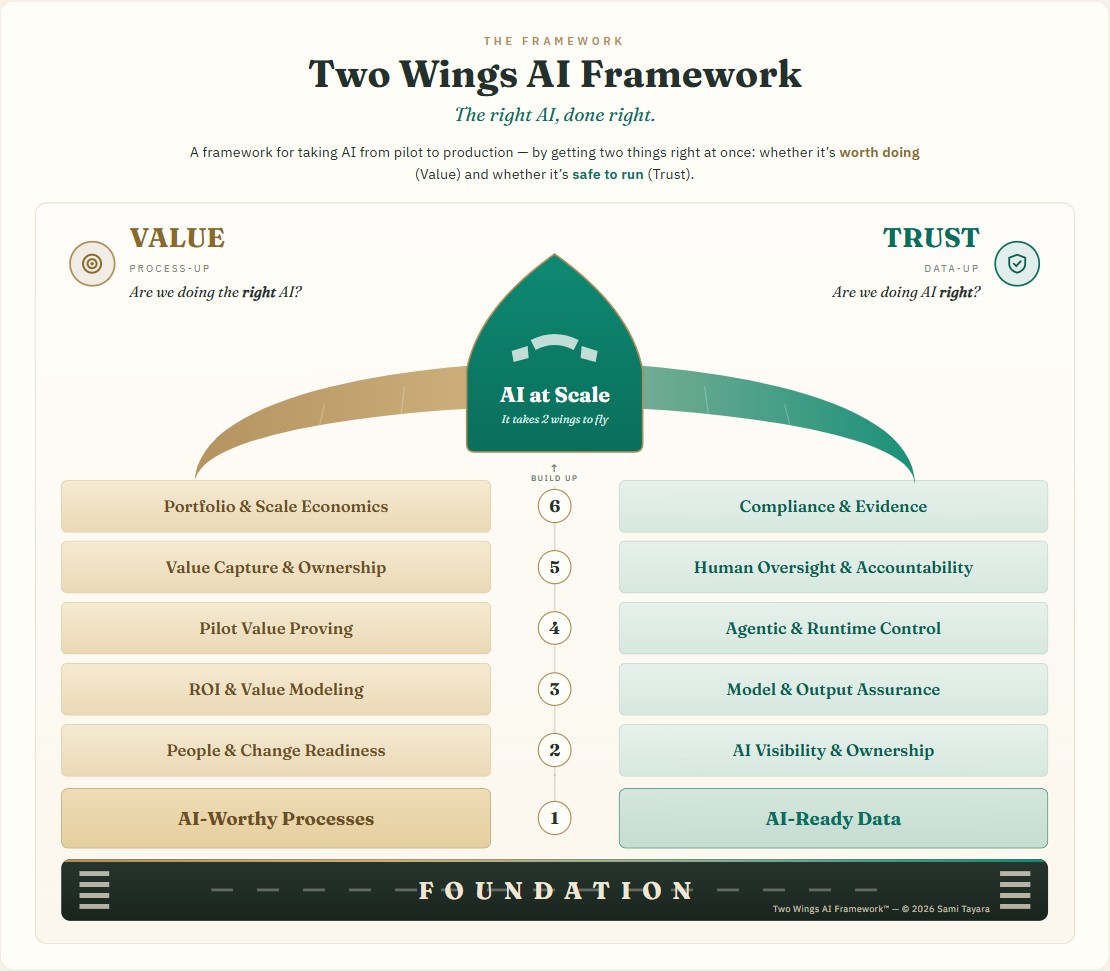
That is the gap the Two Wings AI Framework is meant to close. It governs an AI initiative on two questions at the same time: is it the right AI to build (Value), and is it being built right (Trust)?
Each wing is a discipline in its own right, raised from a foundation — AI-Worthy Processes on the value side, AI-Ready Data on the trust side. They are meant to rise together, not in sequence, toward the point where an initiative is both worth running and safe to run. Applied to a single initiative, the framework becomes a scoring test: only work that holds up on both wings should move toward production. Strong on value but weak on trust is the risky demonstration; strong on trust but weak on value is effort spent for little return; weak on both is better not piloted at all.
What this is — and what it isn't
I want to be precise about what I am offering. This is not a new theory of AI safety, and I am not presenting it as a method already proven across deployments. It is a synthesis — it organises disciplines I have practised for years and aligns each layer to standards that already carry weight: NIST, ISO/IEC 42001 and the EU AI Act on the trust wing; established enterprise-architecture practice on the value wing.
What I am contributing is the framing: that value and trust are not a sequence and not a trade-off, but two wings of one aircraft, to be built together from the foundation up. The foundation beneath the trust wing is not taken on faith, either — published benchmarks show that giving a model governed, well-defined data, rather than raw tables, can raise the accuracy of its answers several-fold. Trustworthy AI rests on governed data; the framework places that foundation on equal footing with the prior question of whether the AI was worth building at all.
An invitation
I am sharing the framework early and in the open — as a lens to be tested, not a finished product. If an AI initiative performs in a demonstration but stalls before production, the Two Wings question is a useful place to begin: which wing is missing? The full framework — the two vectors, the layers within each, and the quadrant for scoring an initiative — is laid out on the Two Wings AI Framework page. I would genuinely welcome your view on it.
Sami Tayara is Founder & Principal of Green Data — Data Management & Governance. The value wing — the economics of turning AI into return — is the focus of Aiconomica. Get in touch or connect on LinkedIn.