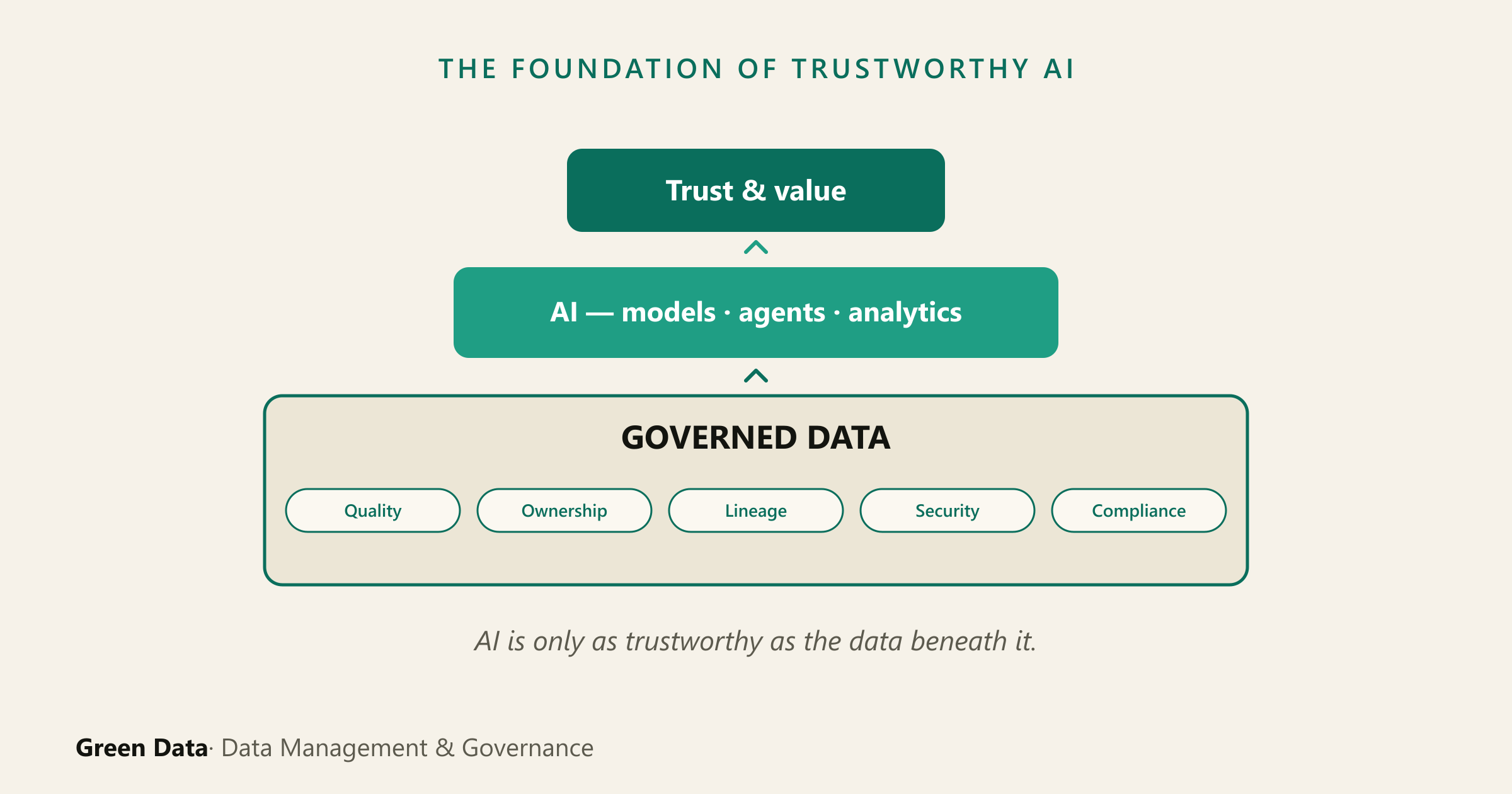
Every enterprise AI conversation I join eventually arrives at the same place: the model is the easy part. You can rent a capable model this week. What decides whether it earns trust — and survives contact with production — is the data underneath it. Trustworthy AI rests on governed data, and ungoverned data is the quiet risk sitting under most AI programmes.
That isn't a slogan; it follows from how data management works. Organisations manage data in order to use it — and if the data can't be relied on to meet a business need, the effort to collect, store and secure it is largely wasted. The old adage garbage in, garbage out predates AI by decades. AI doesn't repeal it; it amplifies it. A model run on flawed data doesn't quietly fail — it makes confident, scaled, hard-to-audit decisions on a flawed basis.
What "governed data" actually means
"Governed" is often heard as bureaucracy. It isn't. Data governance is simply the exercise of authority and accountability over how data is managed — and for AI it comes down to a few concrete properties of the data your model will consume:
- Quality that is fit for purpose. Data quality is measured across dimensions — completeness, accuracy, consistency, timeliness and others — and "good enough" is defined by what the consumer needs. An AI use case sets its own bar.
- Ownership and accountability. Someone is answerable for each critical dataset — its definitions, its quality, its fitness. Data belongs to the organisation, not to the system that happens to hold it.
- Lineage and traceability. You can show where a value came from and how it was transformed. Without lineage, an AI output is unexplainable by construction.
- Access and security. The right people and systems can use the data, the wrong ones can't, and personal data is handled lawfully.
- Compliance. In Saudi Arabia, that means alignment with NDMO data management and personal-data-protection standards, and the maturity the National Data Index (NDI / نضيء) measures.
Govern those, and "trustworthy AI" stops being an aspiration and becomes a property you can evidence.
This is not new to me. I have spent a career building the data foundations that everything downstream — analytics, reporting, and now AI — depends on, and the national frameworks now write the same logic into policy. Saudi Arabia's National AI Index (SDAIA, 2025) scores government entities on their readiness to adopt AI and places data among its core enablers — assessing each on the availability, quality and integration of its data, because data quality directly affects model accuracy — with governance as a measured pillar beside it. Read closely, the national framework for AI readiness is, in large part, a data-governance framework.
Data governance and AI governance are not the same thing
It's worth being precise here, because the two are increasingly blurred. Data governance is the long-established discipline of exercising authority and accountability over data itself: its quality, ownership, definitions, lineage, access and lifecycle. AI governance is newer and narrower: it governs the models and systems built on that data — their risk, transparency, fairness and responsible use. The two are complementary, not interchangeable, and AI governance largely extends data governance rather than replacing it. The dependence runs one way: you can't meaningfully govern a model's behaviour while the data feeding it is inconsistent, unowned and untraceable. Governed data is the ground AI governance stands on.
Governance is continuous, and AI focuses it
Data governance isn't a project with a finish line; it's an ongoing programme — a programme, not a project — that begins as early as an organisation can manage and runs for the life of the organisation. So the useful question is never "is the data finished?" — it never is — but "is the data this use depends on governed well enough to rely on?" This is where a concrete AI use case earns its keep: it tells you which data matters most right now, so the continuous governance effort can concentrate where it will actually be used rather than trying to perfect everything at once. McKinsey makes the same point in Building the foundations for agentic AI at scale: the foundation work is what separates AI that scales from AI that stalls.
Building the foundation
Governed data earns its keep long before AI enters the picture — in trustworthy reporting, lower risk, and decisions you can defend. That trustworthy AI depends on the same foundation simply raises the stakes. Building and governing that foundation is one core service Green Data provides; turning it into AI value is the work of Aiconomica — the two run in parallel, each accelerating the other. And it starts where data work always has — with the fundamentals of sound data management.
Sami Tayara is Founder & Principal of Green Data — Data Management & Governance. Get in touch or connect on LinkedIn.