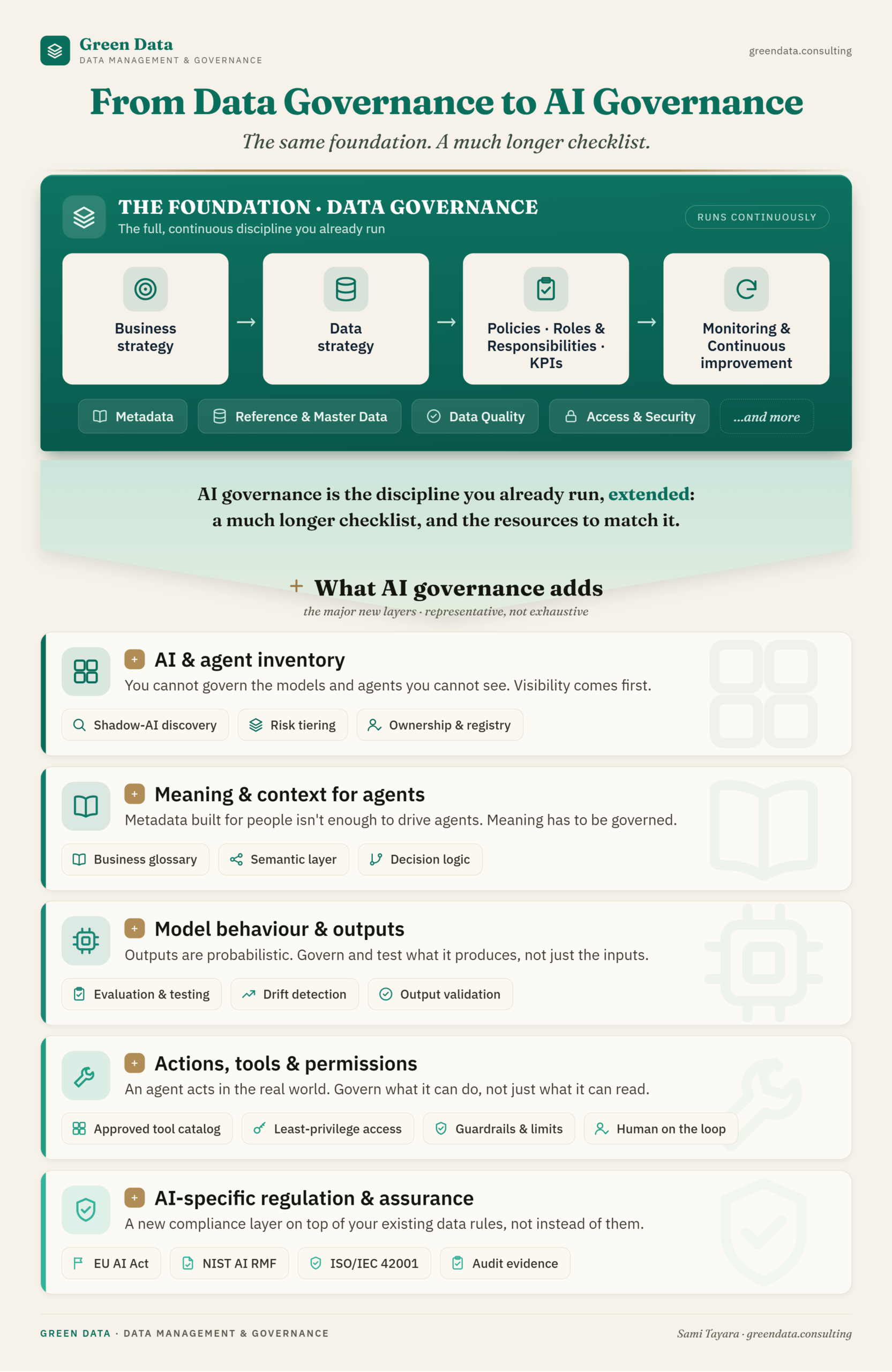
My work is in data management and governance, the discipline that translates business and data strategy into data policy and standards, fixes accountability through owners and stewards, and holds both in place through continuous oversight and measurement. That is the vantage point from which I approach AI governance: a discipline that inherits this operating model and extends it to a far wider scope. The work that matters here is to be precise about what that wider scope actually adds, and what it costs.
Where the gap appears
The clearest way to see the delta is to consider what happens when an agent is added to a workflow in an organisation that has governed its data well but not yet governed its AI. The data beneath the agent is sound: quality is measured, access is controlled, metadata is catalogued. Yet two things can surface that the data-governance checklist never had to name.
The model behind the agent degrades as the world moves away from the data it was trained on. This is concept drift and data drift, and unless its outputs are monitored, the degradation is silent. The data stays as clean as ever; what the model makes of it does not. Separately, the agent will have been granted some set of tool permissions, and unless those permissions were defined with guardrails, the agent acts on whatever scope it was given. The data foundation was governed. The agent operating on it was not. The gap is not in the foundation; it is in everything the foundation was never asked to cover.
Governing AI adds several areas of control that data governance, by design, never had to address. They are predictable: each follows from giving software the ability to reason over data and act on it, and the sections that follow set them out.
The same foundation, a much longer checklist
The controls that govern data remain necessary. They are no longer sufficient. The distinction between AI governance and data governance is a question of layers added on top, not a question of replacing what works.
-
AI & agent inventory. Data governance catalogues the data the organisation chose to load. AI governance has to find what the organisation did not choose: the models and agents adopted quietly, outside any central plan, each tiered by risk with a named owner. And what it finds is rarely a single system. Models accumulate the way tools always have. One team brings in a high-end model for its hardest problems; another picks a cheaper one to keep a high-volume task affordable; a regulated function keeps a smaller model in-house where it needs tight control; and the business software the organisation already pays for keeps switching on new AI features of its own. Nobody chose this collection as a whole. It grew, one team and one contract at a time, which is exactly why no single vendor's admin console can see all of it, let alone govern it. The catalogue that listed the data is not the same as a live registry of what is acting on the organisation's behalf, and that registry has to sit above the individual tools, not inside each one.
-
Meaning & context for agents. This is the delta I have written about at length, and it is the one most easily underestimated. The metadata and catalogues built for data were built for people. A data analyst reads a terse definition and fills in the gaps from experience; an agent has no experience to fill from. It acts on what the metadata states, and where the meaning is ambiguous or was never written down, it does not stop to ask. It proceeds, at scale. So the meaning of the data, including the business glossary, the business rules, and the shared semantic layer, now has to be governed with the same rigour as the data itself. I set this out in Govern the meaning, not just the data: the catalogue that was enough to inform a person is not enough to drive an agent.
-
Model behaviour & outputs. A data-quality rule returns a definite verdict; the same check on the same record gives the same answer every time. A model's output is probabilistic: the same input can produce different results, so it cannot be governed by fixed rules alone. The same unpredictability shows up in how a model follows instructions: a rule placed in its prompt is a request, not a guarantee, so anything that must hold every time belongs in a control outside the model rather than in its instructions. Governance therefore extends to behaviour and outputs: validation before a model goes live, then continuous evaluation, drift detection and output checks run as standing activities rather than one-off project deliverables. This is model risk management, long practised in regulated industries for credit and actuarial models, now applied to probabilistic AI.
-
Actions, tools & permissions. This is where agentic AI governance breaks the most new ground. When an agent acts, whether updating a record, sending a message or initiating a transaction, governance reaches the action itself: the tools it may use, permissions scoped to least privilege, the guardrails around each action, and human oversight by exception. The concern moves from what an AI says to what it does, and doing is harder to govern than saying. It also raises the bar for where the controls live. A permission written into a policy document constrains nothing at the moment an agent acts; the guardrail has to be enforced at runtime, in the path of the action, or it is a record of intent rather than a control.
-
AI-specific regulation & assurance. Alongside existing data-protection and sector obligations, AI carries its own: the EU AI Act [1], the NIST AI Risk Management Framework [2], and ISO/IEC 42001 [3]. These sit on top of the data rules, not in place of them.
The cost most programmes underestimate
Each of those layers brings its own policies, roles and KPIs. Together they make AI governance materially heavier than data governance: a longer checklist, and more active checks and balances behind it. That weight is not uniform, and should not be applied as if it were: it scales with how much a system actually decides and does on its own. Much of what is labelled an "agent" today retrieves or drafts under close human control and needs a light touch; the full stack of controls is earned by the systems that genuinely act. Matching the governance to the autonomy is part of the discipline. What remains true is that this added weight has a cost, and it is the part most easily under-provisioned when an AI programme is planned against the governance budget the organisation already knows.
This year's McKinsey survey of AI trust added agentic governance and controls as a distinct maturity dimension, one absent from the prior year's edition, and found governance trailing the pace of AI adoption in every region [4]. That gap between adoption and governance is the measurable form of under-provisioning: a checklist that grew faster than the resources behind it. Planning an AI programme as though governing AI costs what governing data cost is the specific mistake that leaves the new layers uncovered.
One foundation, built in parallel
None of these additions stand on their own. Output validation, the context an agent relies on, and the limits on what it may do are only as sound as the governed data and controlled access beneath them. An agent working from ungoverned data, with open permissions, cannot be made trustworthy by monitoring after the fact. This is not only a matter of principle. In a Gartner survey of data-management leaders, most organisations did not have, or were not sure they had, the data-management practices that AI specifically requires; Gartner expects a majority of AI projects that lack AI-ready data to be abandoned through 2026 [5]. The foundation still comes first. The AI work, though, does not wait for it to finish.
This is why I treat data governance and AI governance as a single effort rather than a sequence, set out in the Two Wings framework. The data foundation and the AI value built on it advance together, each shaping the other. AI requirements surface data priorities early, and governed data is what makes the AI trustworthy. You do not finish one to begin the other.
Notes
- Regulation (EU) 2024/1689 (the EU AI Act), including its post-market monitoring obligations for high-risk AI systems.
- NIST, AI Risk Management Framework (AI RMF 1.0), 2023.
- ISO/IEC 42001:2023, Artificial intelligence management system.
- McKinsey, The State of AI Trust in 2026: Shifting to the Agentic Era, March 2026. Figures are self-reported survey data; verify any specific figure against the source before publishing.
- Gartner, Lack of AI-Ready Data Puts AI Projects at Risk, press release, 26 February 2025. 63% of organisations do not have, or are unsure they have, the right data-management practices for AI (Q3 2024 survey of 248 data-management leaders); Gartner predicts organisations will abandon 60% of AI projects unsupported by AI-ready data through 2026.
Sami Tayara is Founder & Principal of Green Data, Data Management & Governance, serving the GCC with deep specialisation in Saudi NDMO compliance and NDI maturity uplift. Get in touch or connect on LinkedIn.