Most AI teams I meet are convinced they have a retrieval problem. Their assistants and agents give inconsistent answers, so they reach for more — more context in the prompt, then RAG, then another connected system, then more documents, more metadata, more rules. The answers stay inconsistent. Eventually someone asks the better question: what if the problem was never access to information, but that the organisation never agreed what the information means?
I have spent years building the data foundations beneath analytics and, now, AI, and this is the pattern I see most often. The data is available. What is missing is agreement on what it means.
Just yesterday I watched it happen in miniature. An automated workflow broke at a retrieval step over a single ambiguous phrase — "a responsible person, not a committee." Nothing in the surrounding context made clear that the responsible person had to be internal to the organisation, not an outside consultant. The retrieval resolved the wrong way, the automated chain stopped, and a human had to step in to untangle and fix it. A small thing — and exactly the kind of small thing that, multiplied across an enterprise's agents, quietly drains trust in the whole system.
Retrieval finds the data. It doesn't agree what the data means.
There is a distinction most AI programmes skip. Retrieval answers one question — what information is available? Context answers a different one — what does this information mean in this business? Most programmes pour effort and budget into the first and almost nothing into the second, and only notice the gap when retrieval hits its ceiling. You can connect every system in the company and still get contradictory answers, because the contradiction was in the definitions all along.
Why meaning belongs to nobody
On paper, it doesn't. The data-management discipline already assigns an owner — the data steward — and gives meaning a home: the business glossary and the data catalog. The theory is sound.
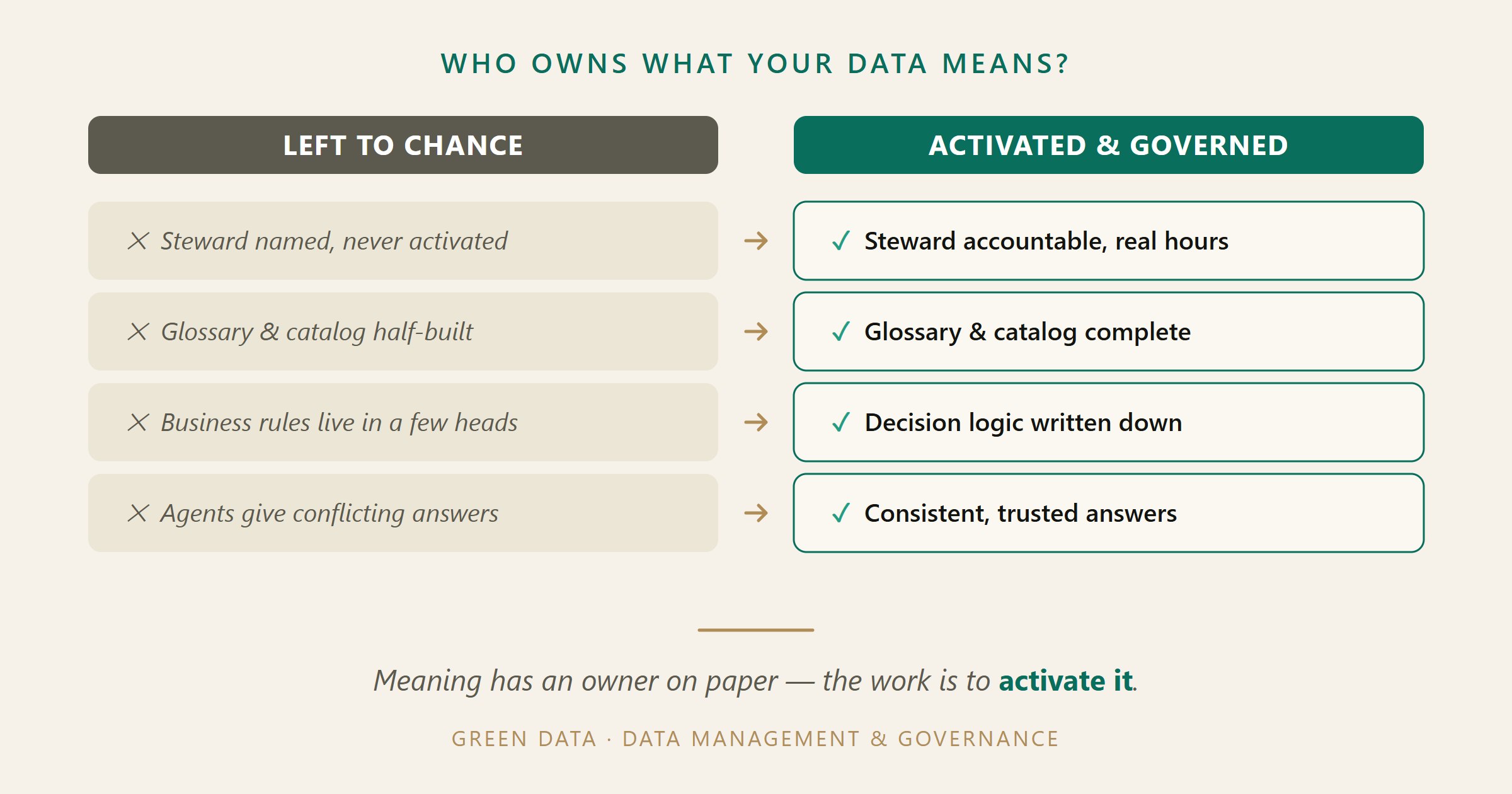
The practice is where it breaks, and here I am describing what I see in the field, not what the textbook says. The stewards are named on a slide but never truly activated — no real authority, no allocated hours. The glossary and catalog sit half-populated, started in a project and never finished. So the owner who exists on paper does little, the repository that should hold the meaning is incomplete, and meaning ends up belonging to somebody in theory and nobody in practice. It gets reinvented, slightly differently, inside every prompt, every workflow, every agent.
And it gets worse with business rules — the shared decision logic of thresholds, trade-offs and exceptions that turn a definition into a decision. If definitions are sparsely documented, that decision logic is barely documented at all; it lives in a few people's heads. AI doesn't create that ambiguity; it operationalises it, and scales it. It's a point a growing number of data and AI practitioners have been making lately, and it matches everything I see on the ground.
Meaning is infrastructure
Organisations have lived this before — with data, with APIs, with the cloud. Each was discovered bottom-up, sprawled into local fixes, and was eventually declared foundational rather than a project deliverable. That declaration is what turned sprawl into strategy. Shared business meaning has not had that moment yet. AI is forcing it.
The reason is simple. A wrong answer from a chatbot is contained and usually obvious. A wrong meaning — unowned, unversioned, running underneath every agent that acts on your behalf — produces wrong actions quietly, at scale. My interrupted workflow was the visible, lucky version; the dangerous version doesn't stop and ask for help. Once AI starts making decisions, "everyone owns the definitions" becomes "no one does" very fast.
The fix isn't a new role — it's activation
Because the discipline already names the owner and the home, the work is not to invent something new. It is to activate what should already exist.
- Activate stewardship. Give each critical data domain a steward who is accountable by name — a person, not a committee — with real authority and real hours written into the role. And define even that precisely: as my broken workflow showed, "a responsible person" is not enough if it doesn't say which person — internal, named, and accountable.
- Complete the repository. A business glossary and data catalog that are actually populated, agreed, versioned and maintained — not half-built and abandoned.
- Capture the decision logic, not just the words. Document the business rules — thresholds, trade-offs, exceptions — alongside the definitions, so a term carries how it is used, not only what it is.
- Make it one source of meaning. A semantic layer that analytics, AI and agents all read from, so they return the same answer to the same question.
This is not new work invented for AI. It is data governance pointed at meaning rather than at rows and columns: the same stewardship, decision rights and quality discipline, applied to what the data means.
The payoff
The organisations getting furthest with AI are not the ones with the most data or the cleanest models. They are the ones that stopped treating meaning as documentation and started treating it as infrastructure — with a real owner behind it. That governed, shared context is exactly what lets analytics, AI and agents return consistent, trustworthy answers across the enterprise — and it is one of the foundations trustworthy AI depends on. Building it — activating stewardship, completing the glossary and catalog, capturing the decision logic — is core to what Green Data does, and the bridge to turning governed data into AI value with Aiconomica.
Sami Tayara is Founder & Principal of Green Data — Data Management & Governance. Get in touch or connect on LinkedIn.