I have set up data governance in many large organisations. I know where it usually fails — and it is almost never the framework. Organisations write a competent policy, convene a council, publish the standards, and then underinvest in the one thing that decides whether any of it survives contact with daily work: the operating model. That operating model is the living arrangement underneath the policy — who decides what about which data, who is accountable when something goes wrong, and how the daily work of stewardship actually gets done. When governance quietly fades into a document nobody follows, the operating model is almost always the reason.
What an operating model actually is
A data governance operating model answers three questions concretely, and by name: who holds decision rights over each domain of data; who is accountable for it; and how the routine work of stewardship — defining terms, setting quality rules, resolving issues — is resourced and carried out. Policies state intent. The operating model is what turns intent into decisions, owners, and daily practice. Without it, a policy is a statement of good intentions with no one on the hook to honour it.
Why operating models don't stick
The failure modes are predictable, and I see the same few again and again:
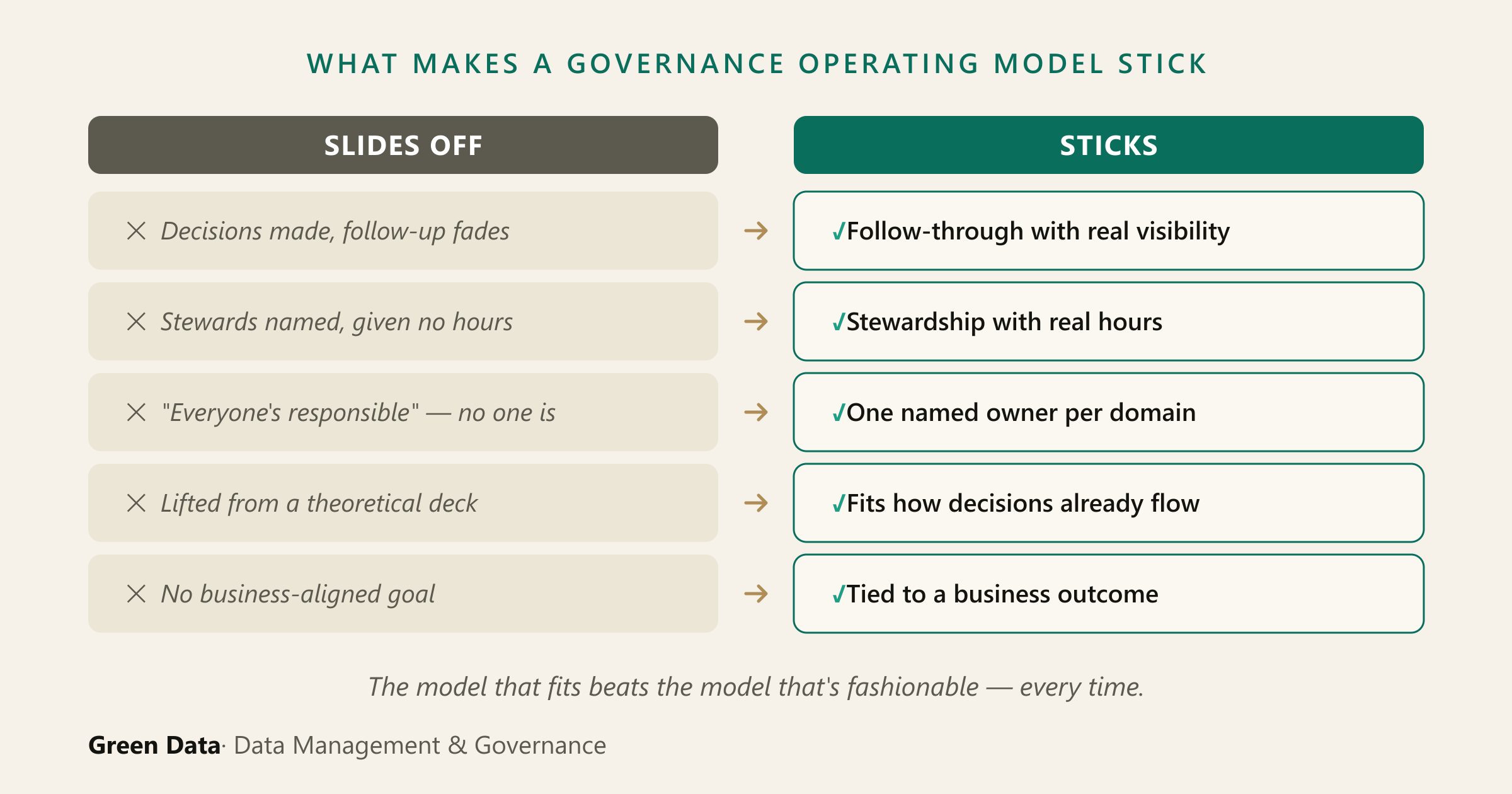
- Decisions that lose momentum. The council makes good decisions, but follow-up is light and progress is hard to see between meetings. The issue is usually energy, not authority: when governance feels like an extra task, even sound decisions tend to drift.
- Stewardship bolted on. Stewards are named but given no time. Stewardship becomes unpaid overtime on top of a full job — the first thing dropped when the quarter gets busy. A steward with no hours allocated is a title, not a role.
- Diffuse accountability. Everyone is "responsible" for data quality, which means no one is answerable for it.
- A borrowed structure. A model lifted as-is from a theoretical deck or a peer organisation and applied to a different culture and org chart, where it never quite fits.
What makes one stick
The models that endure share a handful of traits:
- Decisions that are followed through. The governance body decides — definitions, standards, priorities — and those decisions bind, get acted on, and stay visible through monitoring, rather than fading after the meeting. Authority is rarely the gap; sustained follow-through usually is.
- Named accountability. For each critical data domain, one accountable owner — a person, not a committee.
- Stewardship inside the role. Written into the job, with real hours attached and recognised in performance — not left to goodwill.
- Fit over fashion. The structure matches how the organisation already makes decisions, rather than how a maturity model says it should.
- Tied to outcomes. Governance attached to something the business cares about — a reporting pain, a regulatory deadline, an AI initiative — endures; governance without a business-aligned goal withers.
- Light enough to live with. Enforced, but not so heavy that people route around it.
Choosing the shape
There is no single right structure. The established taxonomy (DAMA-DMBOK) describes three broad shapes — centralized (one organisation governs everything), replicated (every business unit runs the same model), and federated (a central function coordinates standards across units that keep local ownership) — and most enterprises settle on some federated middle. But the choice isn't about which shape is best in the abstract; it's about which fits the way decisions already flow in your organisation. The model that fits beats the model that's fashionable, every time.
The unglamorous part
An operating model that sticks is unglamorous work — decision rights, accountability, stewardship with real hours behind it — but it is the difference between governance that runs the organisation and governance the organisation runs around. The AI field is now loudly rediscovering this same truth: that the operating model, not the tool, decides whether the investment returns anything — something data governance has understood for decades. Designing and embedding that model is one core service Green Data provides; it is also the discipline that trustworthy AI depends on — the bridge to Aiconomica.
Sami Tayara is Founder & Principal of Green Data — Data Management & Governance. Get in touch or connect on LinkedIn.